
The Battle to Govern Artificial Intelligence Has Begun: Why WAICO Could Reshape Global AI Diplomacy and Why India Cannot Remain a Spectator

A New Chapter in Global AI Governance
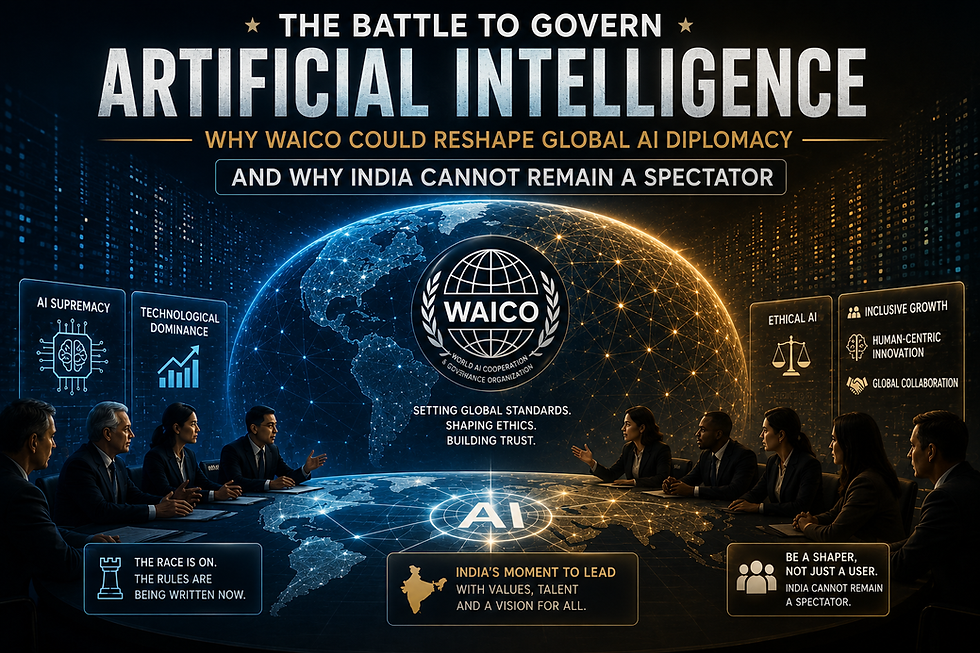
The applause inside Shanghai's World Expo Exhibition and Convention Center was about much more than another diplomatic declaration. As representatives from 29 countries signed the agreement establishing the World Artificial Intelligence Cooperation Organization (WAICO), they were marking the beginning of something far more significant than a new international institution. The gathering reflected a larger shift in global politics. The race over artificial intelligence is no longer only about who develops the most powerful models. It is increasingly about who gets to shape the rules that will govern their use.
For the past few years, discussions on AI governance have largely revolved around voluntary principles, ethical frameworks and summit declarations. Governments repeatedly spoke about "responsible AI" while technology companies continued to release increasingly capable systems at remarkable speed.
The developments in Shanghai suggested that this phase may be coming to an end. WAICO has been conceived as a permanent intergovernmental organisation headquartered in China, with a mandate to promote international cooperation on AI development, governance, technical standards and capacity building, particularly for developing countries. Whether the organisation ultimately succeeds remains to be seen. What already seems clear, however, is that competition over the institutions of AI governance has officially begun.
China's Institutional Strategy
President Xi Jinping left little doubt about China's ambitions. Delivering the keynote address, he said that artificial intelligence "should not be a solo performance by one country, but a symphony of global cooperation." He described the establishment of WAICO as "an important milestone in the history of artificial intelligence development."
Alongside the rhetoric came several concrete commitments:
• 5,000 AI training opportunities for developing countries over the next five years.
• AI application centres to be established with regional organisations including ASEAN, the African Union and BRICS.
• Expanded technological cooperation aimed at reducing what Beijing increasingly calls the global AI divide.
These announcements deserve closer attention than they might initially receive. China's AI diplomacy is evolving into something far more structured than a series of speeches about openness or multilateralism. Increasingly, it resembles the strategy Beijing has followed in infrastructure, trade and digital connectivity over the past decade. Institutions are being established, technical expertise is being shared, training programmes are being financed and governance standards are beginning to accompany investment. The objective is not simply influence today, but influence that remains embedded for years to come.
AI Governance Is Becoming Geopolitics
The participation of United Nations Secretary General António Guterres added another layer of significance to the event. His remarks did not amount to an endorsement of any single country's leadership. Instead, they reinforced a broader principle that is becoming increasingly difficult to ignore.
"Technology that will shape the future of humanity must be shaped by all humanity. It cannot be governed by a handful of countries or a handful of companies. Every nation needs a seat at the table."
Later, he summarised the challenge in even simpler terms:
"Technology must serve people, not the other way around."
His comments reflected an important reality. Artificial intelligence governance is no longer only about ethics or regulation. It has become inseparable from questions of economic development, technological sovereignty and geopolitical influence.
Today, the world's AI ecosystem remains concentrated in a relatively small number of countries and corporations, particularly in relation to:
• Advanced semiconductor manufacturing.
• High quality datasets.
• Frontier AI models.
• Large scale computing infrastructure.
For many developing economies, the central challenge is not merely how to regulate AI safely. It is how to avoid becoming permanently dependent on technologies designed, owned and controlled elsewhere.
Why WAICO Matters?
This is precisely the audience China is attempting to engage. Unlike many Western initiatives that have concentrated on AI safety, frontier model risks and democratic governance, Beijing's diplomatic messaging places greater emphasis on:
• Technological access.
• Industrial development.
• Digital infrastructure.
• Capacity building.
• AI inclusion across the Global South.
Viewed from this perspective, WAICO is not an isolated initiative. It forms part of a broader effort to build an international architecture around China's vision of AI governance. The organisation follows the Global AI Governance Initiative announced by Beijing in 2023 and complements wider efforts to shape global norms for emerging technologies.
Rather than relying solely on existing international institutions, China is gradually building parallel platforms through which standards, partnerships and governance practices can gain international acceptance. Similar strategies have been visible in development finance, digital infrastructure and multilateral cooperation over the past decade. AI governance now appears to be following the same trajectory.
None of this guarantees that WAICO will emerge as the world's leading AI institution. International organisations derive credibility over time, not simply through founding ceremonies or ambitious declarations. Questions surrounding transparency, governance structures, interoperability with existing multilateral frameworks and geopolitical trust will all influence its future. Even so, dismissing WAICO as another symbolic announcement would overlook the larger transformation taking place.
History offers several reminders that institutions often shape global politics long after the headlines surrounding their creation have faded. International organisations governing trade, aviation, telecommunications and maritime affairs gradually became places where commercial interests, regulatory norms and geopolitical influence converged. Artificial intelligence is beginning to follow a similar path.
The question facing governments today is therefore no longer whether the world needs institutions to govern artificial intelligence. The more pressing question is which institutions will shape that governance, whose values they will reflect and which countries will have a meaningful voice in writing the rules.
India at the Crossroads - A Strategic Dilemma
For India, the emergence of WAICO presents a strategic dilemma rather than a straightforward diplomatic choice. Remaining outside the organisation may be understandable given:
• Security concerns.
• Unresolved border tensions with China.
• The desire to preserve strategic autonomy.
Yet there is an equally important risk. If the rules governing artificial intelligence are negotiated elsewhere, India could eventually find itself adapting to standards it had little role in shaping.
Why Participation Matters?
This is not the first time technology governance has evolved in this manner. International standards for telecommunications, civil aviation, maritime safety and internet protocols were all shaped by countries that invested early in institutional participation. Those who stayed away often retained the freedom to reject particular rules, but they forfeited much of their ability to influence them.
India's absence from the list of WAICO's founding members has therefore attracted considerable attention, particularly because every other founding BRICS member has joined the initiative. While New Delhi continues to engage actively through the G20, the United Nations and the Global Partnership on AI, the emergence of parallel governance platforms means that influence will increasingly be distributed across multiple institutions rather than concentrated in a single forum.
Strategic Autonomy Does Not Mean Strategic Distance
This does not mean India should simply join every new organisation that emerges. Nor should AI governance become another arena of binary geopolitical alignment between Washington and Beijing.
India's diplomatic tradition has consistently favoured strategic autonomy over bloc politics. That principle remains relevant today. However, strategic autonomy should not be confused with strategic distance. A country can preserve its independence while remaining deeply engaged in shaping international institutions.
India's Comparative Advantages
India enters this debate with considerable strengths:
• One of the world's largest digital public infrastructures.
• A rapidly expanding AI startup ecosystem.
• Globally recognised expertise in digital governance.
• A growing domestic policy framework through the IndiaAI Mission.
• A long standing commitment to inclusive and development oriented AI.
These strengths resonate with many concerns voiced across the Global South, even if India's preferred institutional pathways differ from China's.
The Road Ahead
The challenge is therefore less about choosing sides than about expanding influence. India should intensify its engagement within existing multilateral forums while simultaneously remaining open to dialogue with emerging institutions such as WAICO.
Even where formal membership is politically difficult, sustained diplomatic engagement, observer participation and technical cooperation could prevent India from becoming detached from conversations that are likely to shape future standards.
The implications extend well beyond diplomacy. AI governance will increasingly influence:
• Cross border data flows.
• Technical standards.
• Certification mechanisms.
• Digital trade.
• Intellectual property.
• Cybersecurity.
• Industrial competitiveness.
Countries that help write these rules will enjoy greater leverage over how global AI markets evolve. Those that merely comply may discover that technological sovereignty is constrained not by capability, but by institutional absence.
Conclusion
The real contest is not between the United States and China alone. It is between countries that shape the governance architecture of artificial intelligence and those that inherit it. India has both the capability and the credibility to belong to the first group. The question is whether it will seize that opportunity before today's emerging institutions become tomorrow's established order.
Sources
https://www.mfa.gov.cn/eng/xw/zyxw/202607/t20260717_11984715.html
https://www.ft.com/content/fd3e703e-7ff7-4561-b039-54b280e4952d
https://www.ft.com/content/ddb316b4-c6ae-4b9b-9d4a-63d63201d4fc
https://english.news.cn/20260717/d4e26796023e48edadbc77b7b6d2d7f8/c.html
https://english.cctv.com/2026/07/18/ARTIBB5cypgqMFAcY2BiPPVT260718.shtml


Comments